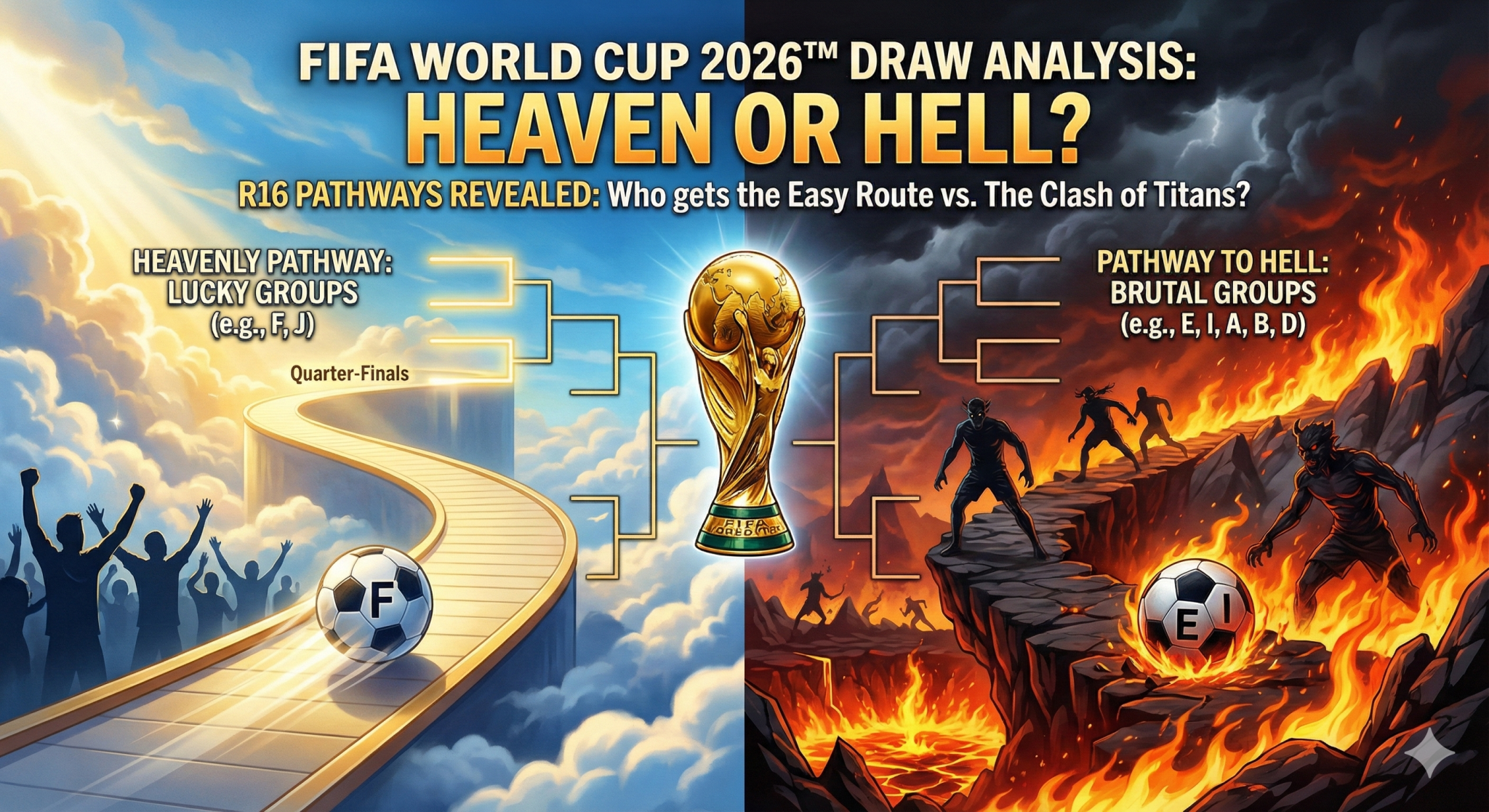
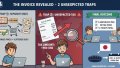
Which groups are 'lucky' and which are 'hell'? Conclusion: F is the best, E/I are the worst.
TheFIFA World Cup 26draw ceremony will be held on December 5 at the John F. Kennedy Center in Washington, D.C. (Japan time: December 6, starting at 2:00 AM).
FIFA has released the Draw Procedures for the FIFA World Cup 2026. How exactly is the World Cup draw decided?
Reading through this document,
"Which groups give you an easier Round of 16 (R16) opponent if you finish first?"
"And conversely, which groups lead to a 'hell route'?"
becomes clearly visible.
In this article, based on official documents, we organize the favorable and unfavorable R16 matchups for group winners.
Key Points of the Draw
1. The 3 host nations are fixed in Groups A, B, and D
- A1: Mexico
- B1: Canada
- D1: United States
These three are treated as Pot 1, but in terms of actual strength:
- Mexico: Effectively Pot 2 level
- United States: Pot 2 to 2.5 level
- Canada: Pot 3 level
is the general assessment, and
this creates a structure where host nations are Pot 1 but their actual strength is modest.
2. The remaining Pot 1 teams go into Groups C, E, F, G, H, I, J, K, and L
This is where true top seeds like Spain, Argentina, France, and England will be placed.
3. The top 4 teams (FIFA Ranking 1-4) are separated into different halves of the bracket
Regarding the top 4 ranked Pot 1 teams:
1st and 2nd ranked teams go to separate halves
3rd and 4th ranked teams also go to separate halves
This is explicitly stated. If Spain (1st) is in one half, Argentina (2nd) is in the other. Same for France (3rd) and England (4th). Since only two Pathways exist, 1st could face 3rd or 4th as early as R16.
The Difference Between R32 and R16 (Where Luck Matters Most)
The 2026 tournament features:
- Group Stage (12 groups x 4 teams)
↓arrow (mark or symbol) - Round of 32 (R32: 32 teams narrowed down to 16)
↓arrow (mark or symbol) - Round of 16 (R16: 16 teams narrowed down to 8)
↓arrow (mark or symbol) - Quarterfinals, Semifinals, and Final
This is the overall progression.
The key point here is:
- R32: 1st vs. 2nd or 3rd, but with multiple possible opponents, it's fairly fluid
- R16: The matchups between R32 winners are completely fixed
.
This article focuses on
evaluating which groups are most advantageous based on the fixed R16 matchups.been declining.
Round of 16 Matchups Overview (If You Finish 1st in Your Group)
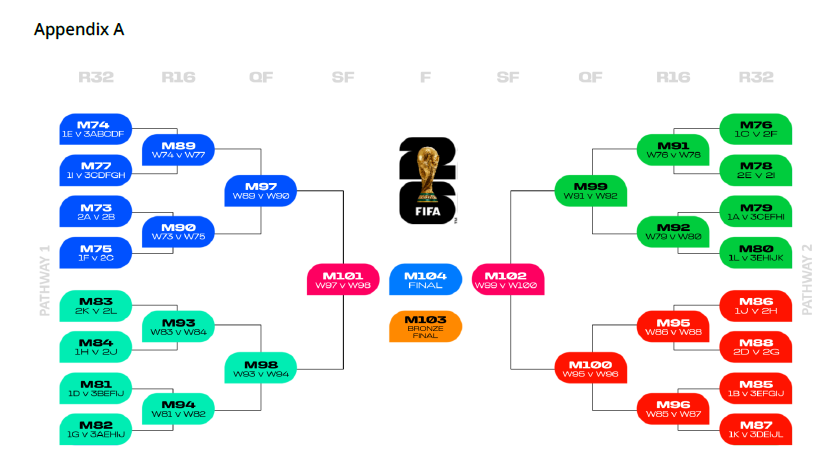
Reorganizing the official bracket (Appendix A)
from a group winner's perspective, the Round of 16 looks like this:
Pathway 1 Side (Groups D through I)
| Group Winner | R16 Opponent (assuming R32 advancement) |
|---|---|
| C1 | Winner of Group E 2nd vs. Group I 2nd |
| D1 (USA) | G1 winner (= another group's 1st place) |
| E1 | I1 winner (= another group's 1st place) |
| F1 | Winner of Group A 2nd (Mexico's group) vs. Group B 2nd (Canada's group) |
| G1 | D1 (United States) winner (= another group's 1st place) |
| H1 | Winner of Group K 2nd vs. Group L 2nd |
| I1 | E1 winner (= another group's 1st place) |
Pathway 2 Side (Groups A, B, J, K, L)
| Group Winner | R16 Opponent (assuming R32 advancement) |
|---|---|
| A1 (MEX) | L1 winner (= another group's 1st place) |
| B1 (CAN) | K1 winner (= another group's 1st place) |
| J1 | Winner of Group D 2nd (USA's group) vs. Group G 2nd |
| K1 | B1 (Canada) winner (= another group's 1st place) |
| L1 | A1 (Mexico) winner (= another group's 1st place) |
What emerges from this is:
- F1 is the only group whose R16 opponent is limited to host nation group runners-up - an overwhelming advantage
- J1 also faces the USA group's runner-up on one side - a relatively easy path
- C1/H1 face runners-up from strong seed groups - not easy, but avoids 1st vs. 1st matchups
- A/B/D/G/K/L group winners face other group winners in R16 - a hellish path
-- that's the structure.
[Definitive Ranking] Lucky Groups Based on Round of 16 Opponents
From here,we rank groups by how favorable the R16 opponent is if you finish first
from that perspective.
(We'll ignore R32 matchups and 2nd-place advancement routes for now, focusing only on: if you finish 1st, what comes next?)
1st Place: Group F (The undisputed jackpot)
R16 opponent: Winner of Group A 2nd vs. Group B 2nd
- A: Mexico (host nation Pot 1, but Pot 2 level strength)
- B: Canada (host nation Pot 1, but Pot 3 level strength)
From these two groups,2ndthe runner-up matchup winner
- GroupsWhether or not upsets happen in Groups A and B, you theoretically avoid facing any truly elite Pot 1-caliber teams.
, aThe most favorable route in the tournamentSimple overall odds: approximately 1 in 80 to 100
If you finish 1st, your R16 opponent is the winner of host nation group runners-up
This means you can start the reservation process before the physical card arrives. Group F benefits the most from draw luck in the entire 2026 tournament.
2nd Place: J / C / H / G / K / L (Effectively facing Pot 2 teams - not bad)
This tier has some internal variation:
(i)R16 opponent: Winner of Group D 2nd vs. Group G 2ndThe winner of 2D vs. 2G
- On one side isthe runner-up from host nation USA's group(not that strong)
- and the other side is a group runner-up
as the matchup.Not as easy as Group F, but still a considerably favorable pathyou could say.Of course, an upset in Group G could bring a strong team into the mix(this analysis assumes no upsets, so please bear that in mind).
For C and H:C1's R16 opponent: Winner of E2 vs. I2andH1's R16 opponent: Winner of K2 vs. L2
So if things go as expected, facing a Pot 2-class team is guaranteed.
G/K/L group winners face a host nation group winner, effectively a Pot 2-level opponent. Finer rankings are possible (e.g., Canada being weaker), but in any case, you're expected to face a Pot 2-equivalent team.
If you want to avoid a brutal 1st vs. 1st matchup in R16, J/C/H/G/K/L are quite decent options.
3rd Place: A / B / D (Easy group stage and R32, but tough R16)
- What these groups share is being in the same group as a host nation, but facing a true Pot 1-class team in R16 is guaranteed.
- Being in a host nation's group is actually favorable this time: finishing 1st guarantees an R32 match against a 3rd-place team.
If your goal is just reaching the Round of 16, this is a great draw. But since Japan aims to win it all, ideally we'd avoid Pot 1 teams until at least the quarterfinals.
4th Place (Last): E / I (The hell groups)
- If things go as expected in this tier,、facing a Pot 1 team is guaranteed.
Moreover, since no host nations are involved, these are true Pot 1 vs. Pot 1 battles (and as noted in our resale post, tickets for these matches are mysteriously being left at very low prices).
On the bright side, R32 is easier for these groups (facing 3rd-place teams).
Summary: In 2026, the bracket path matters more than which group you're drawn into
Analyzing this Draw Procedures document reveals:
- While the 3 host nations (Mexico, Canada, USA) fill Pot 1 slots,
top seeds like Brazil/France are spread across groups K, L, etc. - Due to the top 4 Pathway separation rule,
powerhouses concentrate in zones like E/I and K/L - Since R16 matchups arecompletely predetermined,this means
there are clear paradise routes (F, J) versus tough routes (A/B/D/G/K/L).
This is what we can conclude.
When watching the draw ceremony,
don't just look at which group a team is placed in,
but also consider: if they finish 1st, who do they face in the Round of 16?
Keep that perspective in mind when looking at the bracket.
- If Japan is drawn into a favorable group like F or J, then
a realistic dream of reaching the quarterfinals becomes much more achievable. - Conversely, if drawn into a '1st vs. 1st clash zone' like A/B/D/G/K/L, then
even after winning your first knockout match, there's a high risk of immediately facing a top-tier opponent.
The 2026 World Cup
looks set to be a tournament where draw luck determines your entire path more than ever before.
📌 World Cup 2026 Related Articles
- overpriced, Explanation of FIFA Ticket Policy Revisions
- overpriced, Group Stage Data Analysis
- overpriced, The schedule for the Japan team is decided!
- overpriced, Click here for a summary of ticket information.

Comments